Banking & Financial Services
Citibank (via Wipro)
Modernizing a High-Volume Financial Transaction Platform
Strangler-fig migration behind an API façade, with exactly-once posting guarantees.
Technical Architect from INDIA
· Java & Spring Boot
· Kafka
· GCP & AWS
Building cloud-native platforms for banking, insurance and healthcare
The constraints, the tradeoffs I accepted, and what happened next. View full portfolio or open a deep-dive case study below.
Banking & Financial Services
Citibank (via Wipro)
Strangler-fig migration behind an API façade, with exactly-once posting guarantees.
Enterprise Engineering Productivity
Wipro — cross-engagement initiative
Grounding LLMs in enterprise architecture knowledge to accelerate the SDLC.
And the job is being able to defend the ones you chose.
I am a Technical Architect at Wipro with 12+ years building distributed, cloud-native systems. My work sits where the stakes are highest — transaction platforms that cannot post twice, healthcare journeys that cannot leak, insurance workflows that have to stay auditable for years. I lead architecture across banking, healthcare and retail modernisation programmes, authoring HLD/LLD and ADRs, and setting the design patterns and engineering standards squads build against.
My core is Java and Spring Boot on the back end with event-driven and API-first design — Kafka, Pub/Sub, versioned API gateways — and component-driven React and Angular on the front. I deliver on GCP as my primary cloud, with AWS as a strong second, containerised on Docker and Kubernetes, with CI/CD and observability treated as part of the architecture rather than an afterthought.
Most recently I completed an eMasters in AI and Machine Learning at IIT Kanpur, and I apply that directly: retrieval-augmented generation and agentic tooling grounded in real enterprise context, used to accelerate design and delivery without letting a model become the authority. I have led teams of up to 18 engineers, and I still review code.
HLD/LLD, ADRs, reference patterns and engineering standards
Kafka, Pub/Sub, outbox, saga and exactly-once business outcomes
GCP-first, Kubernetes, Terraform, CI/CD and observability

Java 8–21, Spring Boot, Spring Cloud, JPA, gRPC, REST, API Gateway
DDD, CQRS, Outbox/Saga, Strangler-Fig, Circuit Breaker, Bulkhead, Hexagonal
GCP (primary), AWS, Kubernetes/GKE, Docker, Terraform, Jenkins, Harness, Vault
OAuth 2.0, OIDC, JWT, mTLS, RBAC/ABAC, Zero Trust, envelope encryption, KMS
Distributed tracing, structured logging, Prometheus, Grafana, ELK, RTO/RPO, active-active
RAG, prompt engineering, LLM-assisted SDLC, agentic tooling, Copilot (Certified L3)
Four things I hold to, whatever the stack turns out to be.
The interesting question is never "microservices or monolith". It is what the latency budget, the compliance boundary, the team topology and the failure tolerance actually permit. I design from those constraints outward, and I write down the ones I could not satisfy so the next architect knows what I traded away.
Standards that live in a document get ignored. Standards that ship as a reusable library, a service template or a shared UI module get adopted, because they are the fastest route to done. I aim for reference patterns that squads pick up as the path of least resistance rather than as a mandate.
Large migrations fail at the cut-over, not in the design. I sequence change so every step is small, observable and revertible — façades in front of legacy, incremental extraction, rollback paths rehearsed before they are needed. Slower on paper, faster in practice, because nothing has to be undone under pressure.
A design only survives if the people building it understand why it is that shape. I run architecture-review forums and code reviews as teaching, not gatekeeping — explaining the tradeoff rather than issuing the verdict. The measure is whether engineers start making the same call without me in the room.
Where correctness, auditability and uptime are not negotiable.
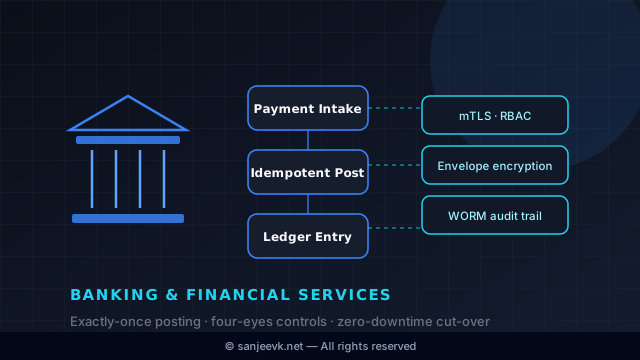
High-volume transaction platforms where a duplicate posting is a correctness failure, not a bug. Strangler-fig modernisation behind API façades, exactly-once posting via idempotency and the outbox pattern, and the security posture a regulated ledger requires — mTLS, RBAC, envelope encryption and immutable WORM audit trails.
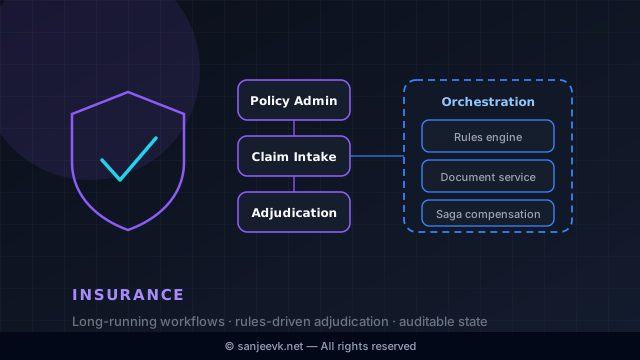
Long-running, rules-driven workflows where state has to stay explainable months after the fact. Java microservices and Kafka-backed processes on AWS, with saga-style compensation for multi-step operations that cannot rely on a single transaction, and security hardening across a multi-team platform.
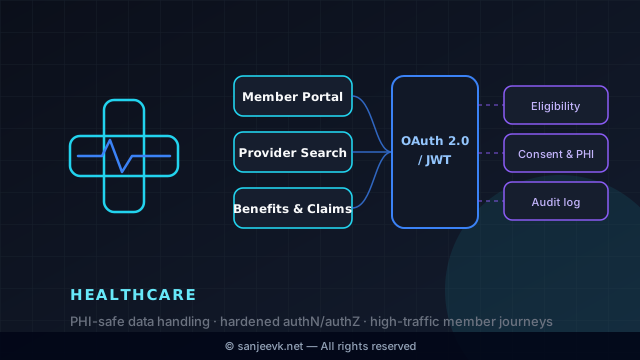
Member- and provider-facing journeys at national scale, where response time and data handling are both under scrutiny. Refactored hot-path backend workflows to improve p95 API response time by 30–40%, and hardened authN/authZ with OAuth 2.0 and JWT to meet healthcare data-handling expectations.
Independently verifiable, and named clients rather than logos I do not have permission to use.
Professional Cloud Network Engineer
Google Cloud Certified
Cloud Digital Leader
Google Cloud Certified
Cloud Practitioner (CLF-C01)
AWS Certified · 2023
Solutions Architect — Professional
AWS · SAP-C02
In progresseMasters — AI & Machine Learning
IIT Kanpur · 2024
GitHub Copilot — Certified (Level-3)
GitHub
Citibank
Technical Architect via Wipro
Modernised a high-volume financial transaction platform; ~35% reduction in production incidents.
UnitedHealthcare
Java Full-Stack Architect via Wipro
Firefly platform; 30–40% p95 API response improvement on critical journeys.
Metro Cash & Carry
Solution Architect via Wipro
Event-driven order pipeline for time-sensitive perishable inventory.
Equifax (DMP)
Senior Full-Stack Lead
Data Lake delivered 60 days ahead of a 90-day plan; 30% faster data retrieval.
CSG Systems International
Lead Engineer — 18-engineer team
Field Service Management on Java/Spring Boot microservices across GCP and AWS.
Xceedance
Senior Programmer Analyst — 8-engineer team
HRMS ERP portal on Java microservices, Kafka and AWS for an insurance services provider.
I write about event-driven design, migration strategy and where applied AI genuinely helps an enterprise SDLC — and where it is still oversold. Recommendations from colleagues and clients are on my profile.
Feedback from engineering managers, delivery leads and engineers I have worked with. Individual names and client identities are withheld under engagement confidentiality — contactable references are available on request.
Sanjeev took a payments stack that everyone was afraid to touch and gave us a migration path we could actually execute. He insisted on strangling the monolith service by service behind an API facade instead of a big-bang rewrite, and that decision is the reason we shipped without a single customer-visible outage.
Reference available on requestWhat sets him apart is that he argues about tradeoffs in writing. Every significant call on the healthcare platform came with the option we rejected and why. When auditors asked us to justify the data flow two quarters later, the answer was already documented.
Reference available on requestWe brought him in for the Kafka design and ended up leaning on him for the whole event model. He was pragmatic about it: idempotent consumers and replay first, exotic patterns never. The pipeline has been quiet in production ever since, which is the highest compliment I can pay an integration.
Reference available on requestHe reviewed my designs without ever writing them for me. I would come with one option, he would send it back asking what breaks at ten times the load. Two years of that changed how I approach system design, and I still use his review checklist with my own team.
Reference available on requestHiring and want to speak to someone directly? Ask for references or connect on LinkedIn.
Longer-form thinking on system design and cloud-native delivery.
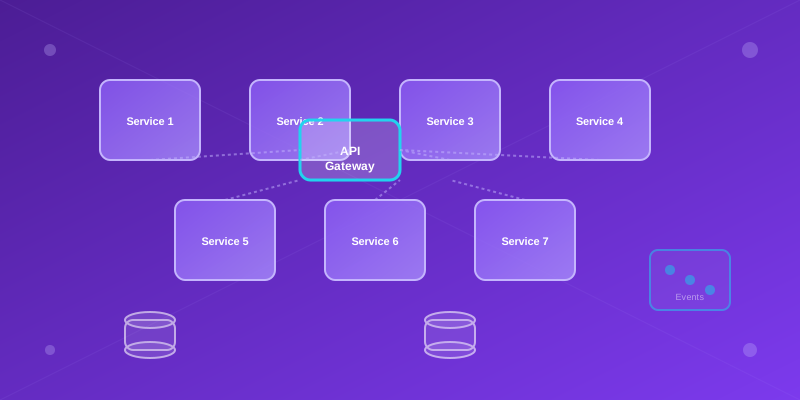
Designing microservices architectures that stay scalable, maintainable and resilient as the estate grows.
Read moreCloud-native architectures, serverless patterns and practices across GCP and AWS.
Read moreArchitectural patterns and practices for building robust, maintainable systems at scale.
Read moreHiring for an architect role, or want a second opinion on a design? I reply within 24 hours.
Delhi-NCR, India
open to Bengaluru, Pune, Chennai & Hyderabad
Available on request
Hiring for an architect role, or want an architecture review? Send the details and I'll respond within 24 hours.